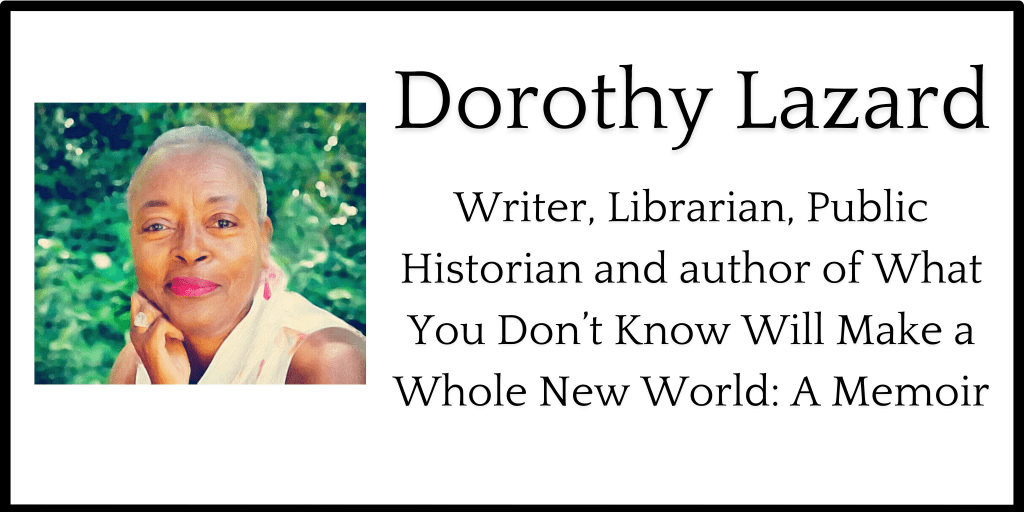
Jordan: Dorothy, what are, what are some of your favorite memoirs?
Dorothy: Oh, I was hoping you’d ask that. My favorite memoirs that I’ve read recently were certainly the one I was most encouraged to read many, many years ago was Mary Karr’s Lit. She was so incredibly honest and so poetic in talking about both her gifts and her foibles and a very complicated family history.
I just appreciated the honesty about herself, about the contentious relationship she had with her mother. And yeah, it was what a memoir should be, if you’re going to bother writing one, be as honest as possible, I think. Another good one that I just finished reading maybe a couple of months ago was Jessica B. Harris’s My Soul Looks Back. And it’s a memoir. I don’t know if you have Netflix, but she is a food historian, and she’s a professor who has written about her early life, about her relationship with an older man. Who knows basically everybody you’d want to know.
James Baldwin, Maya Angelou, just so many famous people, so many famous writers, and she is writing about her life as this young naive girl who’s been exposed to all of these kinds of world class thinkers and world class writers and what that was like and how it helped develop her sense of self.
Her understanding and appreciation of the world and other cultures. Because now she’s as famous as they are all these decades later. She is the host, by the way, of the show high on the hog on Netflix. I don’t know if you’ve watched that.
Jordan: Oh, I’ve seen it. Yeah. It’s really fascinating.
Dorothy: And so it was interesting for me to kind of find and, and, and read about her at a young age when she’s 19, 20 years old and she’s walking through high cotton, as they say.
Jordan: Yeah. Are there certain characteristics that you look for in finding a good memoir? Or is it a situation where people can do it a hundred different ways, but if it’s authentic, then you know it’s good?
Dorothy: You’re looking for authenticity. You’re looking for something that you could relate to. Everybody has a memoir, I think, in them, but if they don’t, If the writer doesn’t communicate to the reader why they even bothered to write the memoir, if it’s not clear, if the writer hasn’t made a connection with the reader some relatable experience or some relatable feeling or awareness.
There are a lot of celebrity memoirs. It’s just like a lot of name dropping, so why are you telling me about these people? Who cares? Tell me why I should care. So, and it’s, the memoirs that I’ve really loved are as different from each other as anything.
I read one I actually just kind of crashed into a few years ago. This is a writer whose name is Steve Pemberton, and he’s a businessman in Chicago. I think he’s based in Chicago, and he wrote a fascinating and kind of a tragic memoir. Part of it’s tragic, but part of it has such a spirit of community, and it’s about his life as a foster kid in this really abusive home.
And he’s trying, but it’s also a little bit of a detective story because he’s trying to find his birth family, and he has a lot to say in there about the community and those people and those teachers who will help save the kid. There were a lot of mentors who helped him through that very fraught time in his childhood.
It was, it was beautiful. I met him at a librarian’s conference at the California Library Association Conference, I think in 2018 or 2019. And we shared a few childhood experiences like an orphanage experience. And so we talked a little bit about that and I thanked him for writing the book because I knew it must have taken a lot of courage for him to do so.
Jordan: Absolutely.
Dorothy: To tell that story the way he told it. Yeah. It’s very brave.
Jordan: So you mentioned celebrity memoirs. I feel like celebrity and political memoirs are the ones that people want. It’s kind of like paparazzi memoirs where you’re just trying to get a peek inside the house to see what was really going on, whether it’s the white house or a house in Beverly Hills, you want to peek in the house. But those memoirs, like you said, often fall into the name dropping game, or there’s a political motive behind them. And they’re not, not necessarily the memoirs I gravitate towards, but I’m curious, from your perspective, what kind of person or what area in life do you think we need more memoirs of?
There’s, there’s gaps in the memoir space, and there’s people’s stories that aren’t being told, but what kinds of memoirs do you think we need more of?
Dorothy: Well, I would like to see more memoirs like my own memoir. I wanted to, when I set out to write my book, I wanted to kind of capture these fading memories of my childhood.
But as I got into the writing, I realized that I hadn’t really read a whole lot of books , like the one I was writing, which was to celebrate an intellectual life of a kid. We have a lot of memoirs about childhood trauma and family dysfunction.
But do we have any memoirs, particularly about kids of color, who are striving to become something else than other than what the media or parents or uninspired teachers are telling them they can be something that celebrates a kid’s imagination without shame, and I realized kind of late in the process that I was writing to those kids.
Jordan: Yeah, well, and this is kind of related to that question, but I just finished. I’m forgetting the name of the book. It’s a memoir that just came out. I think last year it was about a Kid kind of going through the foster care system in California. It was a really fascinating read. But he’s in his early 30s writing this memoir about his time as a child. I’m curious, do you think someone can be too young to write a memoir? Do you know what I mean? Do you need to have the perspective of that time gap between where you are now and what you’re writing about? Or do you think, no matter what point in someone’s life they are at, they can still put down something that’s a reflective piece about their lives?
Dorothy: The old lady in me wants to say, oh, you’re too young, you haven’t lived long enough. But if people have an awareness, and to use your word, if they have perspective, I think they could write a memoir if they’re skilled enough to capture what it feels like to be that kid and to communicate to us readers what it felt like, what was at stake for them how they navigated, troubled waters then I would say, sure, if you have those skills.
And you have that perspective and awareness. And also, of course always the standard if you’re honest about what it felt like.
Jordan: Yeah.
Dorothy: As you can recall, probably , back in the, was it already the 90s or maybe early 2000s when a few memoirists got in trouble for kind of making up stories about their exciting, troubled lives and then you find out it’s all fiction.
You have to start with some honesty, but you also need perspective. Amy Tan says in a documentary about her that PBS ran maybe a year or two ago. You don’t necessarily need trauma to write a memoir. You just need perspective.
Dorothy: You know, and if you’re young and can capture that, and it’s not this what you put out is not just this. Ego stroke, but you can really create something that communicates with people and people can relate to. I think it’s worth doing if you’re so inspired.
Jordan: Yeah. Well, let’s keep digging into memoirs a little bit because it’s so much fun to talk to you about it. Let’s say you’re sitting at your reference librarian desk at the Oakland Public Library and a teenager comes over to you and says, “I’m trying to understand the history of Barack Obama’s presidency,” and he hands you David Garrow’s biography Rising Star, and then he has a Promised Land, Obama’s memoir, and he says, “which one should I choose if I’m trying to understand Obama’s presidency?”
Now obviously the librarian in me, and I’m sure yours would be, say both, but let’s say he says, I can only choose one book. How would you advise him?
Dorothy: I would say, I don’t know, I don’t know if I I don’t know if I choose either of those things. I think I would choose Dreams of My Father. You know, because that really tells us who Obama is on some cellular level.I haven’t read Garrow’s book also. I would definitely show the student both those books. And , as clearly as I can explain, what benefits they offer to the reader what gifts, but yeah, I think I would start with the subject himself writing about his life and his perspective on the world and on himself and on his family because that’s really what I think all people but certainly Obama brought into the presidency that sense of–he used the word in his famous nomination speech. Before he was president. The purple state. There was something about Obama that was so inherently ready to accept any and all people in any and all possibility that people found inspiring and on a political level kind of evolutionary.
So Yeah, I would start there.
Jordan: That makes sense to me. I just did a great podcast with Mas Masumoto, who writes a lot of kind of memoir style essays.
Dorothy: And I love that interview.
Jordan: One of the things we talked about is his memory. And I’m curious about yours. Do you have an exceptional memory for fine details from your childhood or how do you recall such specific things that you write in your memoir?
Dorothy: The things that showed up that were very specific in my memoir are things that I’ve really held on to because I’ve gone over and over and over those scenes in my head. But there’s so much more that I’ve forgotten about. And certainly there’s so much more. I remembered in the process of writing my memoir, things triggered memories, writing certain scenes triggered memories, but as I’ve told different audiences that I’ve had the opportunity to talk to, I don’t see this, or I didn’t intend this as a work of journalism or research. It was literally the story of my memory that Tobias Wolfe says about his own memoir, This Boy’s Life.
It was a story my memory had to tell. I wanted to know that I put the challenge to myself, how robust the story about my childhood. Can I tell just by relying on what’s left of my memory?
Jordan: Yeah. Yeah.
Dorothy: So and of course, this I’m sure this happens to all writers, but of course, there are lots of things that it’s like, Oh, man, I remember that now.
I wish I had put that in the book. But, the book people have now and on their shelves or in their hands is what I had to offer at the time I was writing.
Jordan: Do you think there’s any benefit in misremembering things? I often find when I misremember a family story, I misremember it for a specific reason.
And it gives me some kind of information, and maybe this is because I’m married to a clinical psychologist, but it gives me some information about the feeling that I had as a child in that moment, even if I’m not remembering the quote objective details of the event accurately. So do you think there’s a benefit in misremembering yourself?
Dorothy: Oh, I can see misremembering. As a form of self protection and possibly to certainly communicate family lore because there are certain things that we’ve been taught or reprocessed as children, but we’re misunderstanding what went on or miss, miscomprehending what went on or things weren’t explained and we just assigned some kind of significance to that event or those words or something. And so there’s value in that if that’s what you’re doing. If you know that this isn’t sound information, you know what I mean?
Jordan: Yeah. Yeah. Well, actually you just kind of led to my next question, which is whenever you’re writing about family, you’ve entered the family political space where there are different political parties. There’s different narratives, different campaigns going on for certain individuals for certain stories and the way they should be told. How did you navigate those spaces writing about your family and your life?
Dorothy: I made the decision early on that I had to write the manuscript out in its entirety.
Well, what I considered its entirety. With the belief in mind that this was my story to tell and that there are many, many other family stories to tell about my particular family. I’m just not the one to tell them all. And so this is just my story, my perspective. And so I didn’t do any vetting. I did let my sister, who figures prominently in the book, read it before it was accepted for publication, but it hadn’t been published.
And I let her read it. And once she said, it was okay. And that there was a lot of stuff in it that she didn’t even know about our family, cause if you’ve read the book, you’ll remember that she was back and forth between California and Chicago a lot during her early adulthood.
But once she said it was okay, and she liked it, and, and, and , she was, she’s such a strong reader and, and so astute about what’s being offered by writers I was okay. I didn’t clear it with any other family. And sadly, a lot of the people I write about are dead.
Much to our horror, my cousins and I and siblings, we don’t have elders anymore, they’re all they’ve all passed away. So that’s something though, to be really serious. That’s something that memoirs do have to contend with now whether you have to make the decision I say.
You have to make the decision. How far will you go in the vetting process if you let people read it? Are you going to let them read it while you’re writing it? After you’ve written it? Are you willing to change? And how much are you willing to change the manuscript? Are you willing to include them in the story in a way maybe that you hadn’t intended?
Are you willing to kind of make them a part of the storytelling team or are you just going to tell your own story? So those are hard choices for a lot of writers. But there are ways around that. You could say, if you’re unsure of a thing, I always tell people when I’m doing writing workshops.
You can say, well, this is what I remember, or this is how I remember this, or I was told this story, and that gives you kind of an out that you’re doing your due diligence, you’re trying to tell the story as truthfully as possible, but you’re acknowledging that it might not be the whole truth because maybe you were too young or maybe you were drunk in a frat house or anything could have compromised your understanding or, or experience with some, with some events.
Jordan: And you’re not writing the definitive account of a family. It’s supposed to be the, it’s just your perspective, right? And I think that’s Yeah.
Dorothy: That’s what’s so great about memoir. It’s just a memory.
Jordan: Okay, last question before we jump in the meat of your memoir. When you’re working with a publisher I’m sure that the editing process is interesting, relative to a novel or something in the nonfiction space, like a nonfiction history or something along those lines where you’re telling your vision and version of the events.
How did it look like to work with an editor at a publisher when you’re looking at a memoir?
Dorothy: Grammar voice, of course, voice. I found it, to be honest with you, Jordan, I found it the most challenging part of this whole first time book publishing experience.
Because I knew the editors generally liked the book, what I had presented to them. But then we went. At some point I was working with two different people, and we went round and round about some points of language, particular words were suggested to me to prevent me repeating a particular word more than one.
It wasn’t like a curse word or anything. But it was a word that my family wouldn’t have used at all. It was a word that I connect very much with British English, like BBC English. We wouldn’t have said tinned meat. I mean, that’s not even a concept black people even, what?
It was little things like that. And then there were also particular incidents in the book that I, the way I presented them led to some questions from the editors. But, I kind of dug my heels in a bit because it was my family story. And why are we arguing about this?
This is my family story. And I’m telling you, this is how I received this story. I was relating a story about some major incident in our family history that most people in America know about, I guess many, many people in America know about, but I was telling it from the perspective of how I received the story.
But then there were some, a few editorial challenges about, they didn’t find this in the public records that they consulted. And I was just well, that’s fine. But this is, this is my story. So you have to kind of advocate for yourself in the editorial process. If there’s really something that you don’t want to change, but you have to be willing to defend why you’re taking that stance that you don’t want to change it.
And ultimately, in that particular incident, this was the section of the book about Emmett Till.
The point that we were kind of quibbling over, it wasn’t that big of a point to continue the conversation. I can tell what I’m trying to say here in this chapter without going into the details that has caused this kind of block with the editors. We don’t have to fight about it, I can just tell the story in a different way.
Jordan: Let’s jump into the book in detail. And I don’t want to cover too much because the beauty of the book–and I just finished it this past weekend–and the beauty of the book is actually just experiencing it. I’m a big believer that art is to be experienced. And so I want people to get lost in the story if we give away the cliff notes of everything that happens, that doesn’t make sense.
So I just want to touch on some points that really were interesting to me. And I will start with the beginning. We always start with the beginning, which is, why did you choose to start where you started?
Dorothy: Oh, well, that’s my being a history nerd. I wanted to put it in context. Well, I’ll tell you this. I started out writing this book to commemorate my 50th year in California and what it means to be a Californian. And 50 years seemed a big deal. I didn’t want to just throw a party and because that’s over in a few hours and then you got to clean up afterwards.
But I wanted to say something right away about being a migrant to California because so many hundreds of thousands and millions of people have migrated to California, but what was it like for a black family in the sixties to come to California and live in a very different world than the one that they were used to.
And so I wanted to kind of definitely link our journey west to all of those dust bowl migrants and gold rush 49ers, I guess they’re called. Yeah, I just wanted to make the connections there with the pioneers and the gold rush seekers.
So I wanted to make those connections with those other earlier groups of migrants. Yeah. So I wanted to start there and I wanted to say something about the environment that we drove through those first early days after leaving St. Louis. So yeah, that was my way of setting the story. to get the story going.
Jordan: I was very intrigued by your chapter where you’re at St. Vincent’s. And I was curious what you, what you learned about Roman Catholicism in your time there.What term would we use for a place like St. Vincent’s today?
Dorothy: I would call it an orphanage. It might just be considered a day home. Sometimes they use that term now. Yeah, but I would still call it an orphanage. They called it a day home.
And St. Vincent’s here in Oakland was called a day home. I don’t know why they use that terminology. But the day home that I was in, in St. Louis, was indeed an orphanage though, too.
Jordan: Yeah. And what’d you learn about Catholicism?
Dorothy: I don’t know how to even describe what I felt about it. I would say it was very, what would I call it? Formal and I don’t know. I fell away from Catholicism so quickly in my childhood. By the time I was maybe 12, I had stopped going to mass. It was, I don’t know. It was very formal, not really the right word. I’ll have to think of a better word. There was something very mystical about it. There was something very, I’ll think of another word. Mystical and full of drama, pomp and circumstance. And, there was something very disconnected with the world I lived in and the pomp and circumstances of the pageantry of Catholicism, I didn’t really take in all of the religious or ecclesiastical elements of it.
I didn’t understand what was going on. It was just kind of pretty and it smelled good, but I didn’t really get a sense of what it was the Catholics were trying to get us to believe or follow. Yeah, I didn’t, I don’t know, I wasn’t as devout as say, my older sister, certainly not our dad. So it was a very disconnecting kind of thing for me.
Jordan: For those who haven’t read the book yet, what was the precipitating event that led to the move westward?
Dorothy: The precipitating event was my grandmother coming to the orphanage to retrieve us and bring us back to California, where she had moved to in the early sixties. And so, yeah, she was bringing us to rejoin her clan, the Baskin clan.
All of my mother’s brothers and sisters lived in California. They had moved out from Chicago where they came of age, and it wasn’t until the late 60s that we, my brother, my mother and myself joined my mother’s larger clan here in the Bay Area.
Jordan: There’s so many different moments that I want to touch on.
One that stuck out immediately was the day that Martin Luther King Jr. was shot and your interaction with a man on the street. Can you describe that particular scene and why you think he said what he said?
Dorothy: Well, I actually have interesting memories of that day. I was in fourth grade, I think I was in fourth grade or third grade, and I had just moved to San Francisco to live with my grandmother, my brother, my mother, and I lived with our grandmother on Cole Street in San Francisco.
And there were tons of kids in the neighborhood. It was a very friendly, open neighborhood. It was part of the Haight Ashbery. So there was the hippie contingent in the neighborhood and kids of every imaginable stripe and racial background. So for the first time in my life, we were among people of a variety of races and backgrounds and religion, and it made the whole neighborhood, not to mention hippies, and it made the whole neighborhood seem much, much more interesting than I would have ever thought it would be.
So on the day that Martin Luther King was shot, he was shot in the afternoon. And I had rushed home from school. And there was a newsflash: Walter Cronkite came on saying something along the lines of there being a sanitation worker strike. And there was a news flash and I had come home to watch Dark Shadows, which was a kind of pulpy, gothic mid afternoon soap opera with a vampire.
I don’t know if you’re young, old enough to remember Dark Shadows.
Jordan: I don’t think so.
Dorothy: But it was very campy. And the newsflash broke and we realized something major had happened in the world. And so we all went outside, all the kids kind of gathered outside. And some kid, and mind you, these are kids who are like 7, 8, 9, 10.
And so we’re walking up and down the street trying to figure out, talking among ourselves, what does this all mean? And we’re hearing ambulances, and we’re hearing police cars, and we know something major has happened in the world. And so some kid decides, we should beat up the white people. Because kids are kind of crazy in that way.
One kid said something, and I was like, okay, we’ll follow you. And suddenly a guy comes down the street toward us, but across the street, and he kind of walks over to us with this very grim expression on his face. And he tells us to get home right away. And we’re not understanding why it is this man who we don’t know is really adamant that we get off the street and get off the street right now.
And we find out later that riots had broken out across the country and the man, the stranger, didn’t know. what would happen in San Francisco and he just wanted us off the street to protect us.
Jordan: Yeah, when you were describing wandering around as a kid in the Haight Ashbury in the 1960s, I was just trying to picture, kind of the modern day helicopter parenting, and just the contrast.
I’ve lived in San Francisco before. I didn’t see a lot of kids wandering the streets in the last 20 years.
Dorothy: So sad too. And it’s so sad. We don’t have kids wandering the streets, but I guess people are trying to be cautious and protective of their kids.
Jordan: What was your family’s perception of the hate Ashberry and count counterculture communities and hippies?
Dorothy: They had lived in San Francisco for a few years. By the time that my nuclear family had moved to San Francisco, and they had moved into the Western Edition and then to Haight Ashbury, and then after that they moved back to the Western Edition.
But the Haight Ashbury was an area that my grandmother didn’t pay much attention to. The hippies knew they were there. I put in the book an episode that we had with the hippies at the hippie store on, I think it was on Parnassus and Cole or Parnassus and Carl. And so I don’t know, she didn’t, she didn’t have a whole lot of animosity toward the hippies.
But she also didn’t really understand why with all the privileges that white people had that they would opt to become hippies, why would you want to be dirty or barefoot when you don’t have to be. So I just thought, for me, I just thought it was a thing to marvel that people had those kinds of choices.
Jordan: There’s a section in the book where you talk about a family member twisting their southern tongue to sound more proper. Can you explain what you mean by that?
Dorothy: Well, it’s called code switching, and people do it all the time. I hear people doing it all the time. And it’s not just African Americans doing it, but people who speak other languages, you too.
Where they and particularly Black Southern people, we tend to try to sound as white as possible when the need arises, to sound what they used to call proper, to sound proper, use proper English. And there’s nothing, , there’s nothing wrong with anybody’s accent, but some people think.
It is. So it’s code switching. I don’t talk with my work colleagues, for example, when I work the same way that I talk with my cousins or my friends, the language is different. The slang is different. There’s a casualness to the conversation and the language you would have used with friends.
And family. So that’s something that is very common cross culturally. Yeah, there’s some, there’s something very common cross culturally where you’re kind of unnecessarily suppressing what you’re saying, but changing the way you say it.
Jordan: Another thing I really loved about your book and obviously as someone that was a classroom teacher for a decade.
I love hearing stories about education and personal development and learning and expanding your mind. And what do you think made Mr. Eckhart such a good teacher?
Dorothy: He was just kind and curious. and curious about us and how we looked at the world or looked at ourselves in the world. And I loved him for that.
This was at the time when a lot of us kids didn’t have, had not ever had a black teacher. And I didn’t have a black teacher until I was in junior high school. And I had Mr. Eckhart in fourth grade. And so he was somebody who was, he wasn’t a nun and I had nuns the first couple of years that I was in elementary school and in part of third grade.
And then, and then we just had just regular, common teachers. They weren’t nuns or priests or anything like that. But Mr. Eckhart just, to me, showed us kind of respect and care. And he didn’t come at us with, I would say he didn’t come at us with “Oh, you can’t learn, you’re in my class, but you’re probably going to fail.”
There was a lot of that when I was in school. The black kids were not considered to be. Particularly smart. And so he didn’t present like that at all. This is what you can learn and we can all learn it together. He was very charitable, I would say. He was very charitable in how he viewed us and also just so interesting and interested in everything.
Yeah, he was amazing. And I particularly liked him because he was, he seemed to me, particularly interested in geography and history. And, those are two things that I’ve always been interested in. So yeah, I was honored to share my memories about him because he was such an influence on me. And, a lot of students really liked him.
Yeah, he was amazing.
Jordan: When I lived in San Francisco, I lived for some time in Ingleside right off Ocean Avenue, and I would take the bus to the Western Edition to go to church, actually. I went to a church that shared a building with the Russian center, which is just north of Geary right there.
I’m forgetting the cross streets, but I would get off kind of close to Geary and then I’d walk. I don’t know, 10 blocks to the church. And so I’d spend a lot of time just kind of walking through the Western Edition and you can feel that there’s so much history there. And obviously the history is complicated and I was curious for you.
What made the Western Edition branch of the public library so special?
Dorothy: Oh, is where I discovered how curious a person you could become, and how much of that curiosity could be satisfied in that public library.
Jordan: Was it the librarians, the books they offered, a combination?
Dorothy: It was just the, it was just the variety of books, and the fact that you could touch any and all of them.
I don’t remember any librarian’s name there, but I just remember I felt like I’d gone into a temple. And then there was something about how my family reacted to my budding relationship with the public library in the neighborhood. And my grandmother did not want me to get involved with the library because she thought I would lose the book and she’d have to pay for something and she couldn’t afford to do that.
And, and so no no no. And that just made it all the more enticing because anytime you push the red button right, don’t push the red button and you’re hovering over. And so that’s what the library was for me and just. Knowing just finding out so much stuff about the world and other cultures and different people and different time periods and, , pictorial books and picture books for kids and magazines and stuff.
It was just very wonderful. That was my first I would say serious encounter with the public library. Certainly I had been in public libraries before, but never as an engaged reader as I was when I was 10 and 11 and living on Pine Street in San Francisco. I don’t know if you recall Pine Street, but I think of it fondly.
Jordan: A lot of the streets blend, but there are certain streets that you remember taking. The Muni lines that kind of dictated it. Judah was just very distinct. And then those horrible buses with the extender on them.
Dorothy: The electric rod?
Jordan: Yeah, the electric rod. They had the extender right in the middle. So I’d take the one straight down Geary, and then they would turn slightly. And then, if you were in the middle, you’d feel like you’re gonna fall out on the side of the rubber. Yeah, yeah,
Dorothy: Yeah, the 38 Geary, the 22 Fillmore. Those are all the buses. 47 used to go through the Haight Ashbury.
Jordan: I don’t think they have the little slips anymore. I used to have those little paper slips and I would lose it in my pocket.
There’s so much more we could talk about from your memoir, but I want people just to read it mainly, read it for your amazing descriptions like you talked about before Emmett till the heartbreaking chapter called spiral.
About losing your mother. There’s just so much there, but I want to actually jump to what’s not in the memoir, which is after. I kind of got to the end of the book and I was like, what the hell? I was getting all excited to see where you go as an adult.
And then it just ends. So I’m gonna ask you a few random questions about after yeah. Okay, so I share an alma mater with you. I also went to San Francisco State. Did you have a favorite professor or favorite class you took there?
Dorothy: Oh, Ray Richardson taught black studies and literature.
Angela Davis was a great women’s studies professor there when I was there. I can’t remember any of my English teachers, strangely enough. Oh, Gina Barrio was a great English teacher and a really good writer. She was my teacher and Stan Rice, who was married to Anne Rice, when I went to San Francisco state.
Jordan: There’s an incredible roster, isn’t there? There’s an incredible roster of people at that university out there in the daily city gloom.
Dorothy: In the fog. I had an ear infection the whole time I went to San Francisco state. It was always foggy and freezing. But what was I going to say about yeah, I majored in creative writing at San Francisco State.
I thought I was going to be a journalist when I got into college, but that didn’t last, but I knew I wanted to be a writer. And so I did a bunch of side tracks, I guess you could call creative writing a side track. A sideline.
Jordan: Yeah, so yeah, there’s a skill you kept in your bag.
Dorothy: I did. I did a 38 year detour into librarianship. But I was always writing. I was always writing.
Jordan: Yes, let me. Let me jump to your work as a librarian. What was your favorite part of being a reference librarian in the Oakland Public Library?
Dorothy: Oh my goodness. My favorite part was just working with people to do research.
I really love being a reference librarian. I loved talking to people about what they’re interested in. How did they get involved in what they’re researching? I really liked that. I never wanted to be a cataloger, for example. I always wanted to do the research I always welcomed. I love the fact that it’s in a public library.
You can get 1000 questions in a day, and they can all be really different. I particularly liked working at the Oakland History Center, which I ran for 12 years because I learned so much about the city that I live in and the city that I grew up in. And so I just love the fact that. We could learn something new every day, we could help people really change their lives, improve their lives, and write books.
I loved it when I was working with writers who were working on so many different topics. And just also offering them new ways or fresh ways to look at what they had been researching based on my own knowledge about that subject or curiosity about that subject. And sometimes the reference interview would just be me asking them questions, additional questions.
To what it was they were doing, well, why are you looking at it from that perspective or have you looked at it from this perspective, and sometimes a reference interview would not so much be just answering questions and delivering them information to answer those questions, but it would just be a conversation about the topic or some adjacent topic that would help them broaden how they looked at their subject.
It was, it was, it was really an intellectual dance that I really, really appreciate. And it was the one thing that I missed when I retired in 2021, having those conversations with people about their topics. And sometimes I wouldn’t know anything about their topics which made it even better because I was learning.
Jordan: Yeah. Well, that’s why I love what we’re doing right now as well. Yeah. So, as you well know, libraries are under attack right now.
Not just book banning, but budget cuts, staffing issues, a whole lot. How would you respond to someone that questions the value of our public libraries?
Dorothy: Well, for me, I feel like people need to understand that a public library is number one, free. It’s open to the public. It is something that could supplement whatever it is people are learning in their schools and universities.
It’s extremely helpful to people of all walks of life pursuing any kind of activity, whether it be academic or vocational. And it’s a community builder and it always has been a community builder. The public library has always been there trying to be everything for everybody.
And it does an incredible job in doing that. Now I feel it’s gotten so broad that it can be very trying monetarily and staff wise. For some libraries, you can’t be everything to everybody, but I still think it is one of our best public institutions. It’s our most democratic institution, and it keeps catering to the evolving taste of the American public.
You don’t have to be a citizen, you don’t have to be a taxpayer, you don’t have to be a titled person or an entitled person to use it. And what other institution do we have in this country that you could say that about?
Jordan: And it’s free.
Dorothy: And it’s free. So I’m always proud to be a public librarian. I came to the work mid career but I never found it boring. It was trying but it was never a useless endeavor.
Jordan: Yeah. No, it’s a beautiful mess is what it is.
Dorothy: I love that. I’m writing that down.
Jordan: Let’s, let’s jump to a quick two questions I have about California history. This is a California history podcast. Do you think there’s anything that makes telling Californian stories unique?
So you’re telling your own story, but you’re telling a story about someone that’s a Californian. Do you think there’s anything that makes us unique in the way we talk about ourselves?
Dorothy: Only that we think we’re unique.
Jordan: Okay. So our navel gazing is what makes us unique.
Dorothy: Our navel gazing is profound.
And no, I, well, I think that’s what makes us unique is that we think we’re unique. We are very proud, almost even boastful of our place in the country, our place on the continent geographically. The way we tell stories I don’t think are any different from say a New Yorker or someone from Massachusetts.
I don’t particularly buy into the fact that we’re unique. The thing that makes us unique as I said is our feeling that we are unique. Well, yeah, for lack of a better word, I’ll use the word privileged in some way. Could it be our economy? Could it be our technological innovation? Our GDP? I don’t know, but Californians do feel very special. I don’t know if how we tell our stories is particularly unique or special.
Jordan: How did your feelings about California or the history of California change while you’re writing this book? Are there certain things that in your time reflecting on your personal history? If that affected the way you look at the state or the region’s history?
Dorothy: Only in so much as by writing this story, I was making myself a part of that history, formally a part of that history. And, for example, in my book, I talk about my fascination with the hippies and my fascination with Haight Ashbury as a neighborhood. That’s a story that you don’t hear. I mean, you hear, there was a reason I started the book the way I did, to place myself in what many people feel like is a story they already know.
People think they already know about the Haight Ashbury: there are a lot of hippies there, but what was it like? I wanted the reader to wonder, what was it like for a Black family to be in Haight Ashbury in the late 60s and to give them that slice of a story. So for me, I would love to see more stories about Chinatown or the Mission District or Fruitvale here in Oakland, which is a heavily Latino community.
I’d like to see more memoirists put themselves in a historical context and not just tell this very intimate family story where you could put that story in any location, but really set it. And that’s what I really wanted to do because I am a geography nerd. I really wanted to set it in place. And I think place plays a very key role.
It’s almost a character in my book and I wanted it to be. Because it’s so impactful and influential to me, it meant something for me to arrive for our family to move to Oakland, as West Oakland and many other parts of Oakland were being torn down for redevelopment, quote unquote. It communicated something to me as a person who watched houses being moved and, and, and torn down to build freeways.
That to me was kind of like an apprenticeship. In a way, an apprenticeship, if you would for my time and working in the history room all those decades later because I’d seen so much of the history happened, you know, the food lines and the protest and, and the construction and destruction of, of communities.
Jordan: Well, we always close these podcasts in the same place, which is with book recommendations. What are a few books you’d like to recommend to listeners?
Dorothy: Oh my goodness, you know librarians love those.
Jordan: Should I put a timer on this ten minutes?
Dorothy: Well one I’m looking forward to reading and I’ve been busy with a lot of family stuff lately so I haven’t had a chance to read it is California Against the Sea Visions of Our Vanishing Coastline.
I’m really looking forward to that. That’s also by my publisher, Heyday. One of the best books I read last year was Master Slave Husband Wife by Ilyon Woo.
Jordan: Oh yeah, I’ve been meaning to pick that up.
Dorothy: So good. I mean, it reads like a Robert Ludlum thriller or a John Le Carre thriller. It is so engaging.
And this is a story about two enslaved people, a man and wife, who posed as master and slave to escape slavery. So there was no underground railroad for them. They traveled in these guises.
On trains, on ferries, right out in the open. It was such a bold emancipation story and so well written. And Ilyon Woo last week or two weeks ago won the Pulitzer Prize for history. I was so proud of her. I was in conversation with her at the Berkeley Bay Area Book Festival last May. The organizers asked me to talk with her and we had such an amazing conversation.
Such an amazing conversation. And so that was a great book. Another book, some books you read that are just very paradigm shifting in that they explain something that either you took for granted or you just felt was too complicated to understand and that would be Poverty by America by Matthew Desmond.
Jordan: Yeah, that book hit me hard.
Dorothy: Didn’t it? It was so good. I mean, it was right up there for me with Caste, Isabel Wilkerson’s book on race and racism and caste system, I should say. Yeah, Matthew Desmond’s book on poverty and explaining how poverty is this kind of entrenched part of our national character.
It was, it was, enlightening, discouraging, illuminating, all the things you want nonfiction to be.
Jordan: Well, those are fantastic recommendations. Thank you so much for talking with me. I loved What You Don’t Know Will Make a Whole New World. It was a fantastic book. People need to pick it up now hopefully from a local bookstore or somewhere.
But if you have to go to Amazon.
Dorothy: Don’t go to Amazon, go to https://bookshop.org/.
Jordan: And my last question is always the same. What are you working on next?
Dorothy: I am working on a book about the Oakland main library.
I’m about 160 pages in. I’ve had to stop working on it for a while to address some family stuff, but yeah, it’s kind of a memoir, in that it talks about my time at the library, gives a [00:55:00] little library history, but also, I wanted to kind of celebrate the people who make libraries run, and, and talk about the role, the potential role of what a main library in a city can be.
Jordan: Is it going to have kind of Susan Orlean vibes, but Oakland.
Dorothy: Oh, that was so good. That was so good.
Jordan: Yeah.
Dorothy: I wish it would be that good if I’m that kind of writer, ,
Jordan: I’m pretty confident after reading your memoir.
Dorothy: Yeah. But you know, as, as my grandmother said, what you don’t know will make a whole new world.
And so maybe it will be, I will try to make it as good as Susan Orlean’s book.
Jordan: Yes. Well, Dorothy, this has been a real pleasure. Thank you so much for taking some time to talk with me today.
Dorothy: Thanks for reaching out. I really enjoyed our conversation.
 Jordan Mattox